


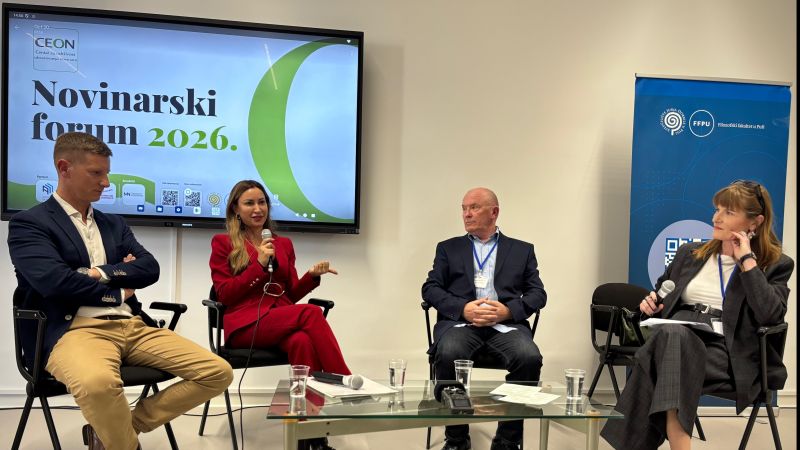
How sustainable is journalism today? What do future journalists learn at university, and what awaits them in newsrooms? What challenges do women face in journalism and the media? How are television broadcasters adapting to the changing media habits of younger audiences? Can social media posts by traditional media outlets influence election outcomes? Are journalists safe while doing their jobs, and how can they protect themselves?
These and many other questions sparked discussions at the first Journalism Forum 2026: Knowledge Transfer on Current Issues, held on 30 October 2026 at the Faculty of Humanities, Juraj Dobrila University of Pula, Croatia, to mark the official opening of the Centre for Sustainability of Journalism Education (CEON).
The Forum brought together researchers, university educators, journalists, editors, and representatives of various institutions and organisations from Croatia and abroad. Through six thematic dialogues, participants exchanged knowledge, experiences, and perspectives on current challenges facing journalism, the media, and journalism education.
The opening discussion on the sustainability of journalism and the media attracted particular attention, as it marked the first time this topic had been explored in this way in a public and professional forum in Croatia. Professor Peter Berglez, from the School of Humanities, Education and Social Sciences at Örebro University in Sweden, emphasised the importance of understanding journalism sustainability through the interconnectedness of the past, present, and future. Lars Tallert, President of the Sustainable Journalism Partnership (SJP), highlighted the need to strengthen the environmental perspective in journalism. Sustainability, in this context, extends beyond responsible business practices and the organisation of media operations to include how journalism covers and addresses environmental issues. The discussion also highlighted the importance of collaboration between CEON and SJP in developing knowledge, initiatives, and joint activities related to the sustainability of journalism and journalism education.
Another important topic was the relationship between innovation, education, and journalists' professional competencies. During the discussion, Assistant Professor Petra Kovačević, from the Faculty of Political Science at the University of Zagreb, highlighted the gap between the knowledge and skills students acquire during their university education and the demands they encounter when entering newsrooms. She pointed out that this gap can affect not only their professional adjustment but also their decision whether to pursue a career in journalism after graduation. The discussion raised important questions about strengthening the connections between higher education and the evolving needs of the journalism profession.
The discussion on women in journalism and the media was particularly powerful, addressing issues of safety, working conditions, mental health, and the challenges of balancing the demanding nature of journalism with personal and family responsibilities. Maja Sever, President of the European Federation of Journalists and the Croatian Journalists' Union, presented two union initiatives: Women in the Media – Stop Workplace Harassment and the Zagorka Connects project. Participants also shared experiences of the challenges faced by women journalists and editors in their daily work, including personal safety during war reporting, constant professional pressure, mental health concerns, and balancing professional responsibilities with their roles as women and mothers.
In addition to these topics, the Forum explored media regulation, trust and distrust in the media, changing television viewing habits, and journalists' safety. The diverse perspectives shared by participants demonstrated how interconnected the challenges facing contemporary journalism are and how essential dialogue among researchers, educators, journalism professionals, and other stakeholders is to understanding and addressing them.
The first Journalism Forum also marked the beginning of CEON's public activities, dedicated to providing holistic support for the sustainable development of journalism education. The exchange of knowledge and experiences throughout the event reinforced the importance of creating spaces where research meets professional practice, and where the questions and needs of the journalism profession can inspire new research, educational programmes, and collaborative initiatives.
All the issues raised and challenges discussed at the Forum highlight the need for such support involving integrating these topics into higher education curricula, supporting journalists' continuous professional development, connecting education with scientific research and the needs of the journalism profession, fostering collaboration among stakeholders across society to strengthen the sustainability of journalism, the media, and society as a whole, and a lot more.
The Forum was held in partnership with the Agency for Media, the European Commission Representation in Croatia, and the Sustainable Journalism Partnership (SJP), with the support of MS Croatian Interpreters.
We extend our sincere thanks to all speakers, participants, partners, and collaborators who contributed to the success of the first Journalism Forum, as well as to the journalists and media organisations that covered the event and helped bring news of it to audiences across Croatia.


Faculty of Humanities in Pula
A: Negrijeva 6, 1. kat
52 100 Pula
Hrvatska
T: +385 (52) 877 436, 099 5342 557
F: +385 211 713
E: ffpu-ured@unipu.hr
W: ffpu.unipu.hr


 Pristupačnost