


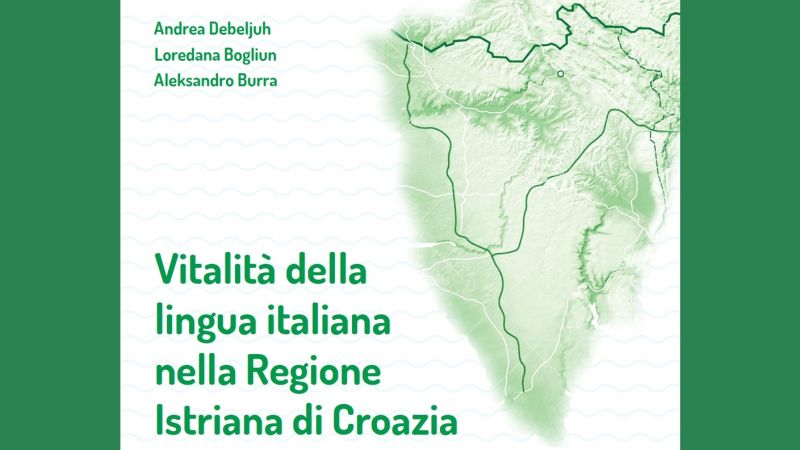
The results of a study on the vitality of the Italian language in Istria County, conducted by Professor Andrea Debeljuh, Dr Loredana Bogliun and Dr Aleksandro Burra, were presented at the Italian Community in Pula. The research provides important insights into the current position of the Italian language in public use and draws attention to the fact that, despite the formally guaranteed status of Italian in the bilingual areas of Istria County, its public presence is not yet fully realised on an equal footing with Croatian. The findings presented indicate that the Italian language in the public space of Istria County is undergoing a process of regression, particularly with regard to its visible, written and oral use within the framework of institutional Croatian-Italian bilingualism. The study is based on the premise that the actual vitality of a language does not depend solely on its formal legal status, but also on the consistent implementation of bilingualism in public institutions, local self-government, education, public-interest companies, administrative communication, public signage and everyday communicative practices. Particular emphasis was placed on the fact that the legal framework regulating the use of Italian derives from international agreements, national legislation and the statutes of Istria County, as well as those of cities and municipalities with bilingual status. However, the study highlights the gap between normatively guaranteed rights and their actual implementation in the public sphere. This gap emerges as one of the key challenges for preserving Italian as a language of the social environment and as a constitutive element of the identity of the autochthonous Italian National Community in Istria.
From a methodological perspective, the authors developed a Model of the Vitality of the Italian Language in Istria, based on UNESCO’s model of language vitality and endangerment. This model was adapted to the local Istrian context and comprises eight factors, including the number and proportion of native Italian speakers, the availability of educational and literacy materials in Italian, institutional attitudes towards the language, the quality of documentation, the attitudes of the heads of public institutions and public-interest companies, the territorial dispersion of speakers and demographic trends observable in population censuses. On the basis of the research conducted, priority measures were proposed to strengthen the public presence of the Italian language. These include the drafting of a unified legal document for the implementation of comprehensive Croatian-Italian bilingualism, the introduction of more effective monitoring and sanctioning mechanisms in cases of non-compliance with bilingualism, the harmonization of Italian-language teaching in schools with Italian and Croatian as languages of instruction, the introduction of bilingual signage and informational materials in public institutions, and the establishment of expert working groups to prepare operational documentation and guidelines for the consistent implementation of institutional bilingualism. The study also emphasises that the preservation of the Italian language in Istria is not merely an institutional issue, but also a broader social, cultural and identity-related matter. In this regard, the importance of raising public awareness, encouraging active citizen participation, involving representatives of the Italian National Community, organizing public debates and thematic meetings, and promoting the use of Italian in the public space is highlighted. Indeed, Italian in Istria, as the language of an autochthonous community and a language of the social environment, can preserve its vitality only if its use is not confined to the formal level, but is consistently and daily implemented in public, educational, administrative and social life.
Vitalità della lingua italiana nella Regione Istriana di Croazia (eBook)


Faculty of Humanities in Pula
A: Negrijeva 6, 1. kat
52 100 Pula
Hrvatska
T: +385 (52) 877 436, 099 5342 557
F: +385 211 713
E: ffpu-ured@unipu.hr
W: ffpu.unipu.hr


 Pristupačnost