


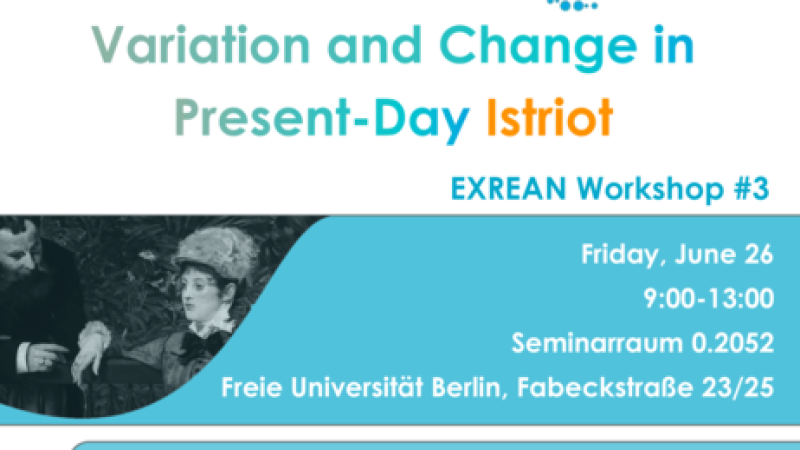
Associate Professor Nada Poropat Jeletić, PhD, Head of the Research Centre for the Linguistic and Cultural Heritage of Istria at the Faculty of Humanities of Juraj Dobrila University of Pula, was a visiting scholar at Freie Universität Berlin, Department of Philosophy and Humanities, in June 2026. During her stay, she participated as an invited visiting speaker at the scientific workshop Variation and Change in Present-Day Istriot, held on 26 June 2026 within the framework of the international research project Experimental Replication of Historical Reanalysis Processes (EXREAN), conducted at Freie Universität Berlin under the direction of Professor Malte Rosemeyer. The EXREAN project is funded by the European Research Council (ERC) through a prestigious ERC Consolidator Grant amounting to nearly €2 million. It is an innovative research project investigating how historically attested processes of linguistic reanalysis can be experimentally replicated under laboratory conditions by integrating insights from historical linguistics, psycholinguistics, experimental pragmatics and social psychology. The project systematically examines processes of reanalysis and semantic change as simultaneously cognitive and social phenomena, with particular emphasis on Romance languages and on the conditions under which semantic innovations emerge, spread or cease to develop. The scientific workshop Variation and Change in Present-Day Istriot was devoted to Istriot, the endangered Romance idiom of south-western Istria, which represents a highly significant yet still insufficiently explored object of study in contemporary Romance linguistics. The aim of the workshop was to bring together scholars working on variation and change in Istriot and to demonstrate that precisely such minority and contact-induced varieties provide an exceptional opportunity for observing processes of language change in real time. Associate Professor Nada Poropat Jeletić delivered an invited lecture entitled Italophonic Configurations in the Istrian Contact Zone: Repertoire Dynamics, Polyglossic Stratification and Language Governance Regimes. In her presentation, she examined the linguistic ecology of Istria as a complex communicative space shaped by long-term historical processes of Romanisation, Venetian expansion, successive imperial administrations, national restructurings and post-socialist language policies. Particular attention was devoted to the internal stratification of Istrian Italophony, the relationships among Standard Italian, Istro-Venetian, Istriot, Croatian and the Čakavian dialect, as well as to the asymmetrical polyglossic configurations in which linguistic prestige, everyday language use, institutional status and symbolic value do not necessarily coincide. Alongside Associate Professor Nada Poropat Jeletić, the invited speakers also included Assistant Professor Alberto Giudici, PhD (University of Teacher Education of the Grisons; University of Zurich), a member of the Centre for the Research of the Linguistic and Cultural Heritage of Istria at the Faculty of Humanities in Pula and Rita Rumboldt (Freie Universität Berlin).
Assistant Professor Alberto Giudici presented a paper entitled The Istriot Noun Phrase and Language Contact, in which he discussed his research on the grammatical development of the Istriot plural indefinite quantifier uni/une, a phenomenon representing an innovation within the Italo-Romance domain. He also examined the influence of language contact with Slavic languages and Istro-Venetian varieties on the development of the Istriot noun phrase and its inflectional classes. Rita Rumboldt presented new research on the conditions and scope of the grammatical development of the Istriot form uni/une, drawing on experimental evidence and a comparative perspective with Standard Italian. Her doctoral research, conducted within the EXREAN project, focuses specifically on contemporary developments in Istriot and on the experimental investigation of grammaticalisation processes in this endangered Romance idiom of Istria. Participation in a scientific meeting of this calibre is of particular significance for the Faculty of Humanities of Juraj Dobrila University of Pula and for the Centre for the Research of the Linguistic and Cultural Heritage of Istria, as it confirms the international recognition of the research conducted at the institution while further strengthening academic ties with one of Europe's leading universities. At the same time, this participation opens new opportunities for international scholarly collaboration, academic exchange and joint research initiatives dedicated to the documentation, analysis and promotion of the linguistic and cultural heritage of Istria.
.jpeg)
.png)
(1).png)


Faculty of Humanities in Pula
A: Negrijeva 6, 1. kat
52 100 Pula
Hrvatska
T: +385 (52) 877 436, 099 5342 557
F: +385 211 713
E: ffpu-ured@unipu.hr
W: ffpu.unipu.hr


 Pristupačnost